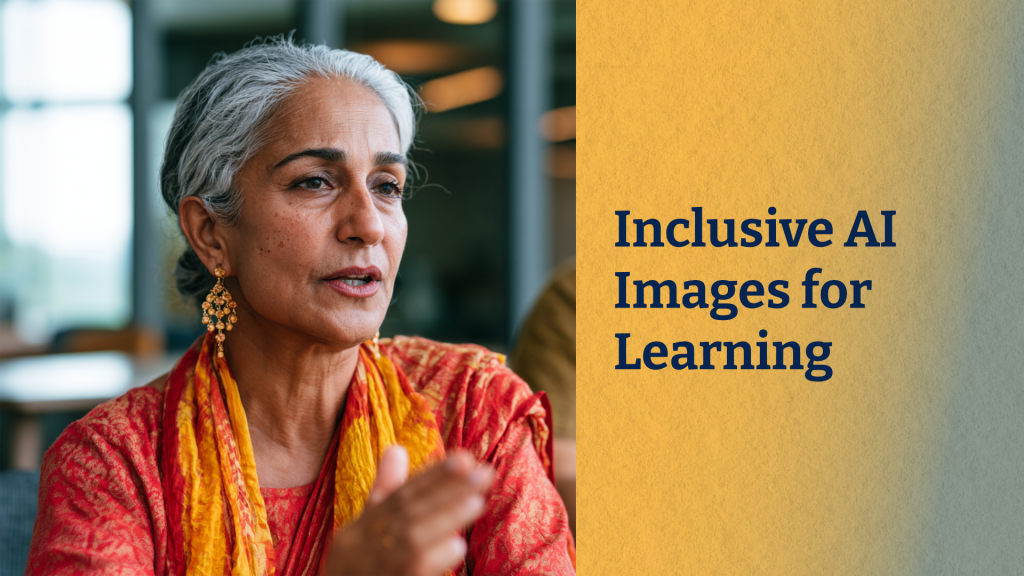
AI-generated images often reflect bias and exaggerate stereotypes related to race, gender, age, and disability. AI models are trained on stock images that often don’t show equitable representation. In addition, the way AI image tools predict likely images can amplify biases. However, with the right tools and prompts, AI-generated images can be more inclusive than the traditional stock images we often use in training. This is the challenge I addressed in my session for the Accessible and Inclusive Design Conference hosted by the Training Learning and Development Community.
You’ll learn strategies for writing more effective image prompts to minimize bias and reflect more inclusive representation in your learning. You’ll get tips to more authentically represent your training audience by using AI images. While AI tools are improving all the time, they still have limitations that you need to be aware of. We’ll discuss some of the ongoing challenges with inclusive representation in AI image generation and options to minimize those issues. You’ll leave with a collection of sample image prompts, a prompt framework for better results, plus tactics to make your AI-generated images more inclusive.
Watch the recording
If the video isn’t embedded below, you can watch the presentation recording on YouTube.
Download the slides
Most of the time, I don’t share my slides for presentations. My slides aren’t all that useful on their own, so I build separate handouts with more comprehensive information. However, in this case, where the focus is often on both the inclusive AI images and the prompts to generate them, having the images of the slides is helpful.
AI still can’t show left-handed writing
One of the observations I shared in my session is that AI image generators still can’t show someone writing with their left hand. That’s partly because the majority of images of people depict right-handedness. That becomes the default prediction for the AI when showing writing, and I haven’t found any AI image model that can override that default.
For example, here’s Nano Banana’s result for this prompt:
Editorial photo, a left-handed woman writing in a notebook with her left hand in a charming coffee shop, focus on the hand, notebook, and table. An iced latte is on the table next to the notebook.

Is left-handedness the most pressing issue related to inclusive AI images? Of course not! But it’s an example of how AI predictions about the most likely results can amplify stereotypes in images. The same types of predictions happen with gender, race, ethnicity, nationality, hair, skin color, disabilities, assistive devices, body type, and more.
Generating images of a range of body types
AI images tend toward slender body types. Adding descriptive phrases like “average weight” or “slightly overweight” can help counter that.
These four images all used the same prompt except changing the body type as shown.
Style: Candid iPhone photo
Subject: Greek woman, mid 30s, black wavy hair, olive skin
Body type: [Very thin, athletic; Average weight; Slightly overweight; Obese, heavyset]
Clothes: Blue and white floral shirt, tan slacks
Action: Laughing at a joke, pointing
Setting: On the sidewalk, outside a cafe
Lighting: Golden hour
No signs or text


More on inclusive AI images
- Disability Representation in AI Images
- Nonbinary Characters in Scenarios
- Considerations for Using AI Images Ethically
- Minimizing Bias in AI-Generated Images (My AIDC presentation last year)
Upcoming events
Instructional Design Uncovered: A Community Conversation with Instructional Designers. September 10. ATD Research Triangle Area
Creating High-Quality AI Media: Prompting, Scripts, and Consistency. October 8. Register for the ATD AI Intensive.
Creative Solutions with Twine: Design, Streamline, and Refine Branching Scenarios. October 14. ATD Dallas Learning Technology SIG
DevLearn

Register for DevLearn by October 2 for the Advanced Rate. Save an extra $100 with code CHRISTY.
Branch Smarter, Not Harder: Naming Conventions, Variables, and Bottlenecks in Storyline
- November 3, 2026 at 9:20 AM
- CE01: Storyline & Rise Pro Lab
Cohesive by Design: Generate Consistent AI Icons, Illustrations & Characters
- November 4, 2026 at 10:00 AM
- BYOD (Bring Your Own Device)
Buzz Discussion: Video & Media
- November 4, 2026 at 3:45 PM
The post Inclusive AI Images for Learning appeared first on Experiencing Elearning.