
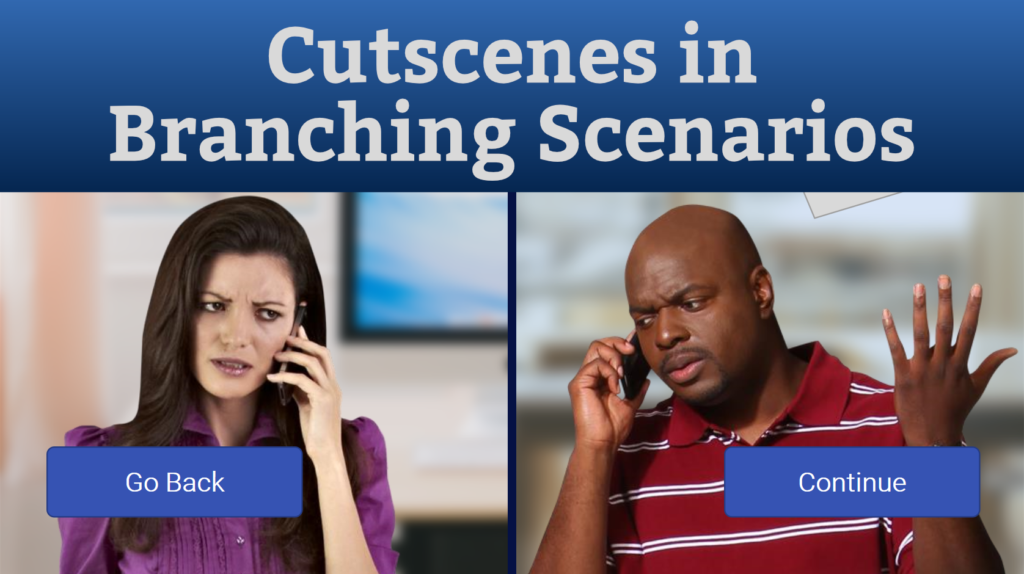
In video games, cutscenes are short, non-interactive scenes that “cut away” from the action. They can move the plot forward, show conversations, or build emotion. We can borrow this technique from video game design when we develop branching scenarios for learning. Using cutscenes helps manage the complexity of building branching scenarios.

In branching scenarios with simulated conversations, sometimes I see people build every single exchange as an interaction. With that approach, if you’re controlling a character, then every single sentence that comes out of that character’s mouth has to be a decision point. It can get pretty tedious, both for the user and for the ID building it.
Example without a cutscene
Here’s what that might look like with some dialogue excerpted from the middle of a larger scenario.
Decision point 1
Sophie: OK, so you have two big goals with moving to online. First, you want to eliminate the travel costs. Second, you want the training to be shorter, in smaller chunks, so managers can still do their jobs while they’re being trained. Has the training itself been successful so far?
Robert: Yes, our classroom training has been well received. We have good scores on our satisfaction surveys.
What should Sophie ask next?
A. Are you measuring anything else about the effects of your training?
B. Have the trainers provided any feedback on what could be improved?
C. What level elearning do you want the final product to be?
Decision point 2
Robert: What do you mean?
What should Sophie say next?
A. Change the topic; this level of evaluation isn’t important at this stage.
B. Give an example of a measurable business outcome.
C. Explain Kirkpatrick’s 4 levels of evaluation.
Decision point 3
Sophie: Well, this is manager training, right? So maybe one outcome from that would be lower turnover for employees whose managers have been through the training.
Robert: Ah, I see. That would be great, but I don’t have any of that data right now. Could you help me figure out how to measure that? I’d love to be able to show that value to my managers.
What should Sophie say next?
A. Sorry, but you’ll have to get those numbers to me before we can proceed.
B. I can include that in the price for the project. Let’s talk about road mapping.
C. I can include that in the price for the project. Let’s talk about more details so I can give you a firm estimate.
With a choice for every line of dialogue, that creates 3 decision points, each with 3 choices. That’s 10 screens that have to be built.
Example with a cutscene
Compare the version above to this version using a cutscene. This time, all of the dialogue continues seamlessly. You see some back and forth between the two characters before having a single decision point at the end. Instead of 10 screens, this is only 4 to build (the conversation shown here plus the results of the 3 choices).
Sophie: OK, so you have two big goals with moving to online. First, you want to eliminate the travel costs. Second, you want the training to be shorter, in smaller chunks, so managers can still do their jobs while they’re being trained. Has the training itself been successful so far?
Robert: Yes, our classroom training has been well received. We have good scores on our satisfaction surveys.
Sophie: Are you measuring anything else about the effects of your training?
Robert: What do you mean?
Sophie: Well, this is manager training, right? So maybe one outcome from that would be lower turnover for employees whose managers have been through the training.
Robert: Ah, I see. That would be great, but I don’t have any of that data right now. Could you help me figure out how to measure that? I’d love to be able to show that value to my managers.
What should Sophie say next?
A. Sorry, but you’ll have to get those numbers to me before we can proceed.
B. I can include that in the price for the project. Let’s talk about road mapping.
C. I can include that in the price for the project. Let’s talk about more details so I can give you a firm estimate.
See the cutscene in action
You can see the cutscene in action on its own or as part of the complete branching scenario. This full cutscene includes some additional dialogue prior to the script excerpt shown above.

I wrote about the specifics of building a simulated phone conversation previously.
Advantages of cutscenes
Simplify the scenario
The biggest advantage of showing a conversation in a cutscene like this is reducing the total number of slides (from 10 to 4) and decision points (from 3 to 1). That reduces time building the other options, as well as the time writing plausible distractors for the additional decision points.
Reduce cognitive load
Trimming extraneous decision points helps reduce the cognitive load on users. With a cutscene, they can see the conversation and focus their efforts on the decisions that matter. They don’t need to put in cognitive effort on the less important decisions of every line of dialogue.
Meet critical objectives
The cutscene moves the conversation forward quickly to get to the next critical point. In this particular example, the objective is to propose a road mapping. That needs to be a decision point.
The other parts of the conversation aren’t as critical for the learning objective. Therefore, it’s not as important for them to be decision points. I can collapse that dialogue into a single, non-interactive conversation. We need the context, but not everything has to be a decision point.
More tips on streamlining branching scenarios
For more tips for making branching scenarios easier and more manageable, download my guide on Streamlining Branching Scenario Planning and Design. This is a free 25-page PDF guide on how to save time and manage the complexity of branching scenarios while still providing rich, valuable learning experiences.


Originally published 3/3/2020. Updated 4/23/2026.
Upcoming events
Better Prompts, Better Representation: Inclusive AI Images for Learning
- Wednesday, May 20 at 3 PM EDT/ 12 PM PDT
- Register for this free webinar hosted by Training Mag Network
The post Cutscenes in Branching Scenarios appeared first on Experiencing Elearning.