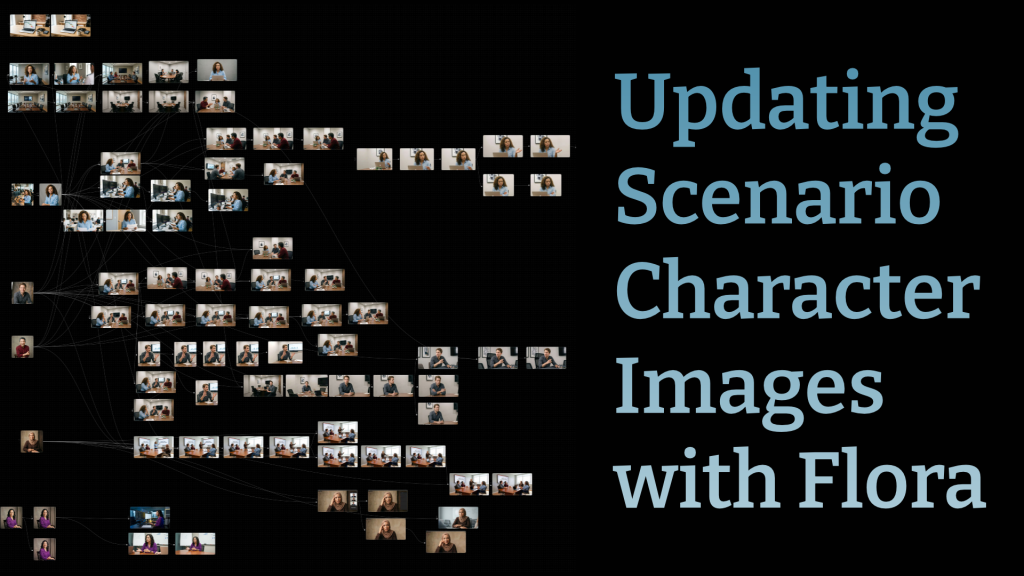
In my last post, I explained my process for updating one of my Twine branching scenarios using Claude to build a new interface. In this post, I’ll share how I updated the character images in Flora. Most of the images were generated using the Nano Banana model (the image generator in Gemini), but I use Flora because it’s easier to manage reference images and get consistency. I also used Flora’s tools for upscaling images, changing camera angles, and more. With current AI tools, it’s much easier to put multiple characters into a scene. Even though Flora is easier to work with than using a chat interface, the whole process took me several hours to generate new character images for this scenario.
You can try the scenario with the updated images now. This is more of a beta version than an alpha version, but there still may be some problems.

Reference images and planning
Reference images are key to getting consistent characters across multiple images. I started by generating images of each character looking at the camera; these are my clean reference images that I refer to later. These all look very posed because I prompted for a “studio photo,” but that’s fine since these are just reference images.


Since I was already working with Claude on the updated user interface, I prompted Claude for a list of the images and poses I needed. That saved me some time in my planning. I also generated an image of a conference room as the setting for the initial team meeting in the scenario. I named all of these reference images with the character names.
Generating scenes with multiple characters
Assembling scenes with multiple reference images is really easy in Flora. You just type your prompt and add @ before the name of the image. That’s why I named each reference image with the character names.
Style: Editorial photo
Subjects: @Samantha @Jake @Alex
Setting: @Small conference room, laptops on the table
Action: Having a meeting, discussing
In the screenshot of Flora below, you can see the thumbnails of the reference images for each character plus the setting.

Changing camera angles
To provide some variety in the scenario images, I changed the camera angle for some images. As you can see in these two images, they’re the same scene, but with the camera angle changed.


I used Flora’s image tool for changing the camera angle to accomplish this change. That uses a model called Qwen Image Edit that has special options for directing where the camera should be. As you can see below, you can set both horizontal and vertical angles plus a Zoom. That means I have a lot more control than just prompting Nano Banana to change the camera angle (which I never have much luck with).

Unfortunately, while Qwen does great overall at changing the camera angle and keeping objects pretty consistent from different angles, it didn’t do well at all at keeping the characters consistent. They look sort of like my characters, but they lost a lot of detail. The people have that very airbrushed AI image look that I’m trying to avoid. That meant I had to do another step to prompt Nano Banana to replace the people in this image with the characters from my reference images.

Time and cost for scenario image creation
I spent about 5.5 hours generating the images for this scenario. While I can batch image generation in Flora to speed up the process, that process didn’t work with this project. I needed to get the scenes right and then build from there, so each image built on the previous one. Once I got a few scenes right though, I maybe could have done some batches to get multiple poses of people talking and listening.
I could generate characters with transparent backgrounds and assemble them into scenes, the way we all did with cutout images in the past. Sometimes that might be faster, although I think it would have taken longer for this particular project.
My total time includes some time where I was task switching though. Image generation is usually fairly fast, but I still find myself switching to check email or my phone while waiting. Am I always switching right back to the image generation as soon as it’s done? Probably not. I don’t have a solution for that right now, but it’s something I observe in my work.
My cost for generating 100+ images was about $9. Combined with the cost of redesigning the UI with Claude, my cost is about $15 total.
Over 100 images generated
While there are only 22 images in the final product, I generated over 100 images in Flora. All of the edits and regeneration means I’m only keeping about 20% of the images I generate. I hear similar ratios of 20-40% from other people who use AI for media generation. Image generation is about your prompting and ideas at the beginning, but also about your judgment and refinement throughout the process. Don’t believe any hype about how AI is a magic button that you click once and get great results out of; there’s a ton of refinement, iteration, and sometimes manual editing involved.
Interactive video
I’ve thought about changing this to an interactive video scenario. There’s a fair amount of dialogue here that would lend itself to video. (Although as I’ve been rereading this scenario, I see a number of places I’d like to edit.) I might do that as a future update. I’m sure the time and cost will be quite a bit higher though; video generation is a lot more expensive and time consuming. It might be a good project to build my skills with AI video though.
What do you think? Would you like to see this scenario as a video? I could do some more of these working out loud posts to show my process.
Find any glitches?
If you find any glitches in the scenario, please let me know! Generating the images took a lot of time, so I haven’t spent as much time testing as I’d planned. I suspect there may still be some issues for me to resolve.
Looking for more?
I’ve published a number of articles on AI image generation, particularly around character images.
- Updating a Twine Branching Scenario with AI – Part 1 (My previous post about updating this scenario)
- Speed Up Character Image Creation with Flora
- Comparing AI Image Generation Tools
- Testing Freepik Spaces for Character Image Generation (Freepik is now Magnific, but the basics of this post are still accurate.)
- Nano Banana (Gemini) Character Image Experiments
You can also check out all of my posts about AI and instructional design as well as my growing collection of over 70 posts on scenarios and storytelling.
The post Updating Scenario Character Images with Flora appeared first on Experiencing Elearning.